Engineering Reliable Connectivity for Safety-Critical Wearables
SlateSafety is an Atlanta-based connected safety company focused on eliminating preventable worker injuries and deaths. Its technology is built for demanding environments including heavy industry, nuclear facilities, military operations and other settings where real-time information can play a critical role in worker safety.
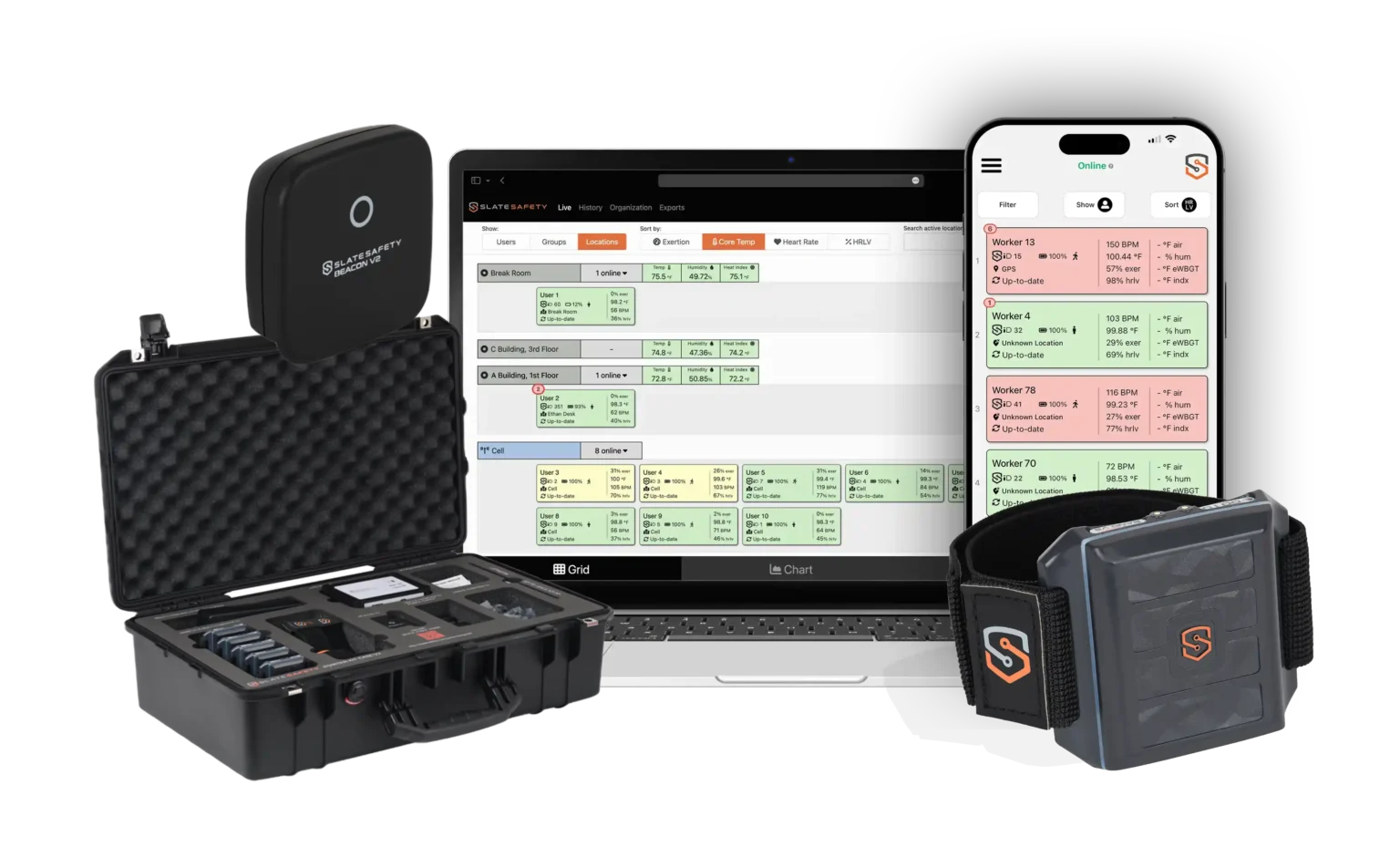
Their BAND V2 physiological monitor is a compact wearable. It reports
core body temperature, heart rate, exertion, location and falls in
real time. Sensing is only half of it. The data still has to reach the
person responsible for the worker wearing it, and industrial sites are
hostile to exactly that.
Where the RF gets hard
Dense facilities present difficult RF conditions. Structural steel,
machinery and restricted work areas attenuate cellular signals. A
wearable also leaves almost no room for an antenna. Those two
constraints pull against each other, and the form factor is the one
that cannot move.
SlateSafety answers this with a multi-channel architecture. The device
uses cellular, BLE-connected gateways and mobile relays, and caches
data locally when nothing is reachable. That covers the network side.
The antenna side is where they brought in F3.
What F3 did
F3 worked on antenna integration, RF design, testing and certification
for BAND V2 and BEACON V3. The engagement covered:
– Custom LTE antenna design
– Antenna integration and RF design reviews
– Pre-compliance RF testing
– FCC and ISED certification support
– Connectivity performance inside a compact wearable form factor
The LTE antenna had 48 x 39 x 6 mm to live in. F3 went looking for an
off the shelf part that would both fit that volume and perform in it,
and did not find one. So F3 designed a custom flex antenna instead,
tuned for 700 to 800 MHz and 1700 to 2200 MHz so that a single build
covers the US and the EU. F3 also impedance matched the Wi-Fi, BLE and
GNSS chip antennas, which sit on a small ground plane next to a Li-ion
battery. Gain, efficiency and radiation patterns were measured in an
antenna measurement system rather than estimated from simulation.
A volume that small does not give an antenna much bandwidth. Matching
cannot create bandwidth, it only trades one band against another. That
is why the antenna was designed around a specific band plan rather
than trying to cover everything at once.
“F3 Wireless and its team of experts accelerated our product development timeline and helped us overcome major challenges when it comes to RF design for small form factor wearables.”
Tyler Sisk
CTO, SlateSafety
“F3 has completed our full design and product development, including documentation, manufacturing guidance, test, and certifications. F3 helped us understand the technical trade-offs including sourcing for production quantities and builds, as well as product documentation. Just because your company doesn’t have an engineering team, that doesn’t mean you can’t have your own products.”
– Maggie Davis, General Manager of GotRad
Download the GotRad Story